Understanding Hardware Fittings for HV Transmission Lines up to 765kV
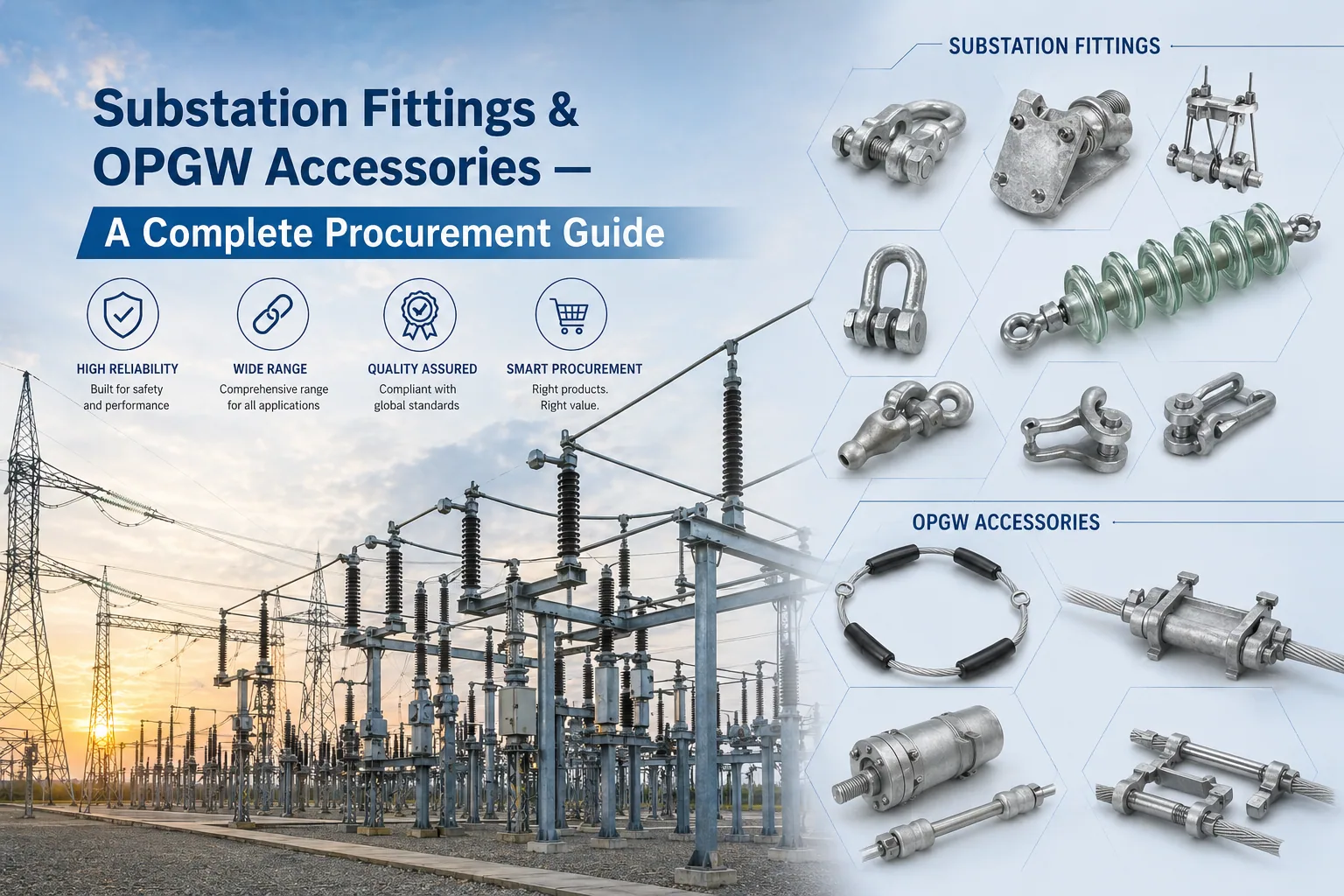
High Voltage (HV) and Extra High Voltage (EHV) overhead transmission lines form the backbone of power distribution networks. As line voltages scale from 33kV up to 400kV and 765kV, the mechanical stress, electrical fields, and environmental loads on conductor hardware increase exponentially. At these extreme levels, choosing the correct transmission line hardware fittings is critical for safety, efficiency, and system longevity.
1. Types of Hardware Fittings and Their Functions
Hardware fittings serve two primary purposes: securing conductors mechanically to the towers and managing the electrical stresses (like corona and radio interference) associated with EHV transmission.
- Suspension Hardware Fittings: Designed to suspend the conductors vertically from insulator strings on intermediate support towers. They must accommodate line oscillations, wind loads, and protect the conductor from bending fatigue at suspension points. Envelope-type or AGS (Armoured Grip Suspension) clamps are typically used to distribute clamping pressure evenly.
- Tension / Strain Hardware Fittings: Used at dead-end or angle towers where the conductor terminates or turns. Tension clamps must hold the full mechanical tension of the conductor under maximum wind and ice loading. Typically made of high-strength forged steel or compression-type aluminum alloy.
- Bundle Spacers and Spacer Dampers: On 400kV and 765kV lines, multiple conductors are bundled together per phase (e.g., twin, quad, or hex bundles) to increase current capacity and reduce corona losses. Spacers maintain the geometry of these bundles, while spacer dampers combine spacing with vibration damping to control sub-span oscillations.
- Vibration Dampers (Stockbridge Type): Aeolian vibration, caused by low-velocity wind blowing across conductors, creates high-frequency standing waves that can lead to fatigue failure of conductor strands. Stockbridge dampers absorb this energy, protecting the conductor from stress concentration.
2. Design Considerations for EHV (400kV & 765kV) Fittings
At 400kV and 765kV, standard hardware design is no longer sufficient. Engineers must account for:
- Corona Control: The high electric field strength at EHV levels causes ionization of air (corona discharge), leading to power loss, audible noise, and radio interference (RIV). EHV fittings feature rounded contours, polished surfaces, and are equipped with corona rings to distribute the electric gradient away from sharp hardware edges.
- Dynamic Wind Loads: EHV towers support heavier conductor bundles over longer spans. Fittings must endure extreme mechanical strain, including high gust wind loads and short-circuit electromagnetic forces.
- Material Selection: Aluminum alloy (extruded or cast) is used for components in contact with aluminum conductors to prevent galvanic corrosion. Forged steel, hot-dip galvanized to IS 2629 standards, is used for load-bearing link items (shackles, ball eye, socket clevis) to ensure maximum mechanical strength.
3. Technical Specifications and Compliance Standards
All transmission line hardware must meet rigid national and international standards to qualify for utility projects (such as Power Grid Corporation of India - PGCIL):
- IS 2121 (Parts 1 to 4): Indian Standard for conductors and guide accessories for overhead power lines.
- IEC 61284: Overhead lines — Requirements and tests for fittings.
- IEC 61897: Overhead lines — Requirements and tests for Stockbridge-type aeolian vibration dampers.
Choosing a manufacturer with an in-house NABL-accredited laboratory and CPRI/ERDA type testing certification is the single best way to ensure project compliance and prevent catastrophic field failures.
Need Certified Transmission Hardware?
Transcom manufactures quality-approved transmission line tools and substation fittings up to 765kV. Get in touch for custom OEM drawings or tender inquiries.