Why NABL-Accredited Type Testing Matters for Transmission Hardware
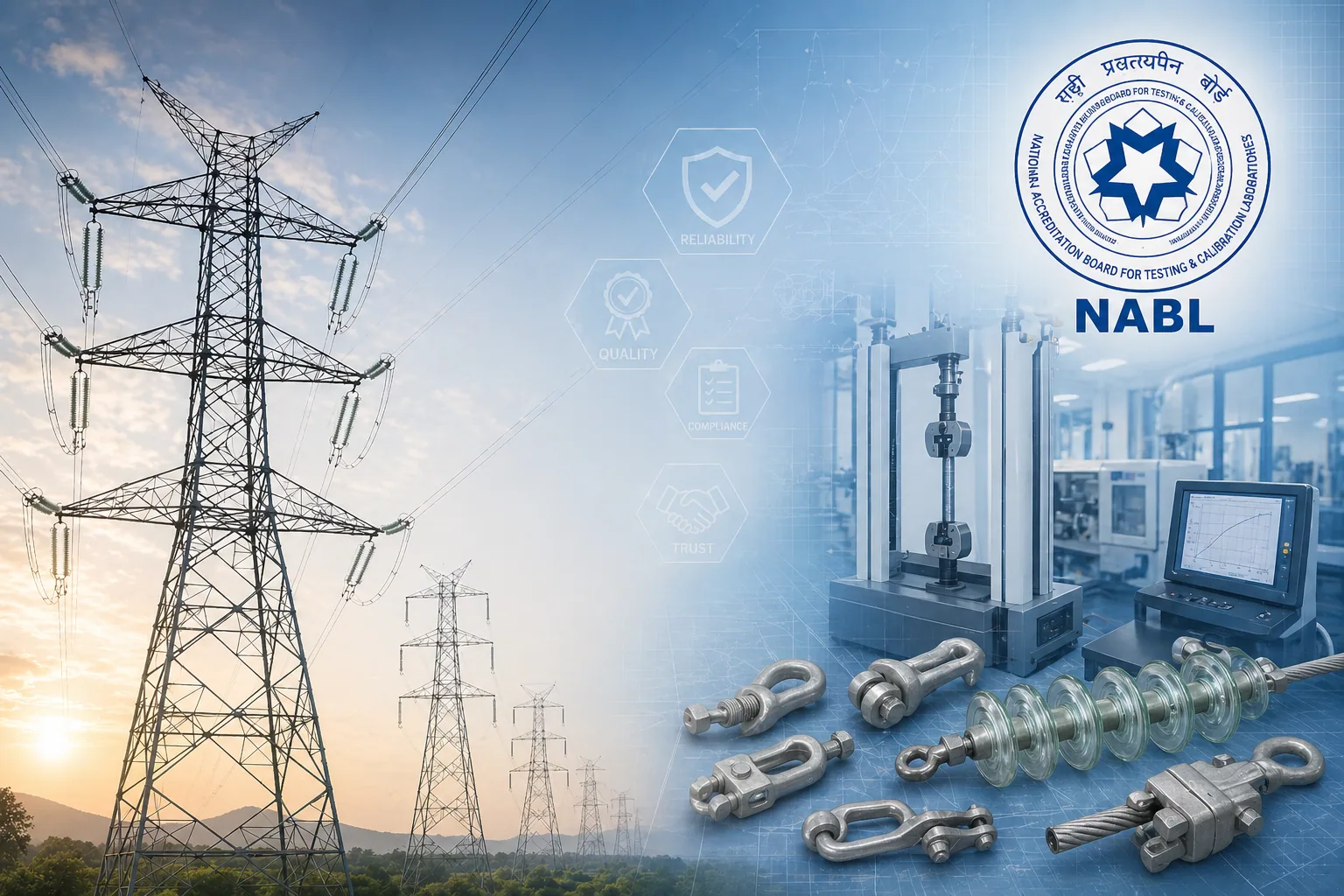
In power transmission infrastructure, failures are costly and dangerous. A single faulty suspension clamp or sub-standard tension assembly can cause a conductor drop, leading to grid blackouts, massive revenue losses, and safety hazards. For EPC contractors and utility developers, verifying the quality of hardware fittings is paramount. This is why NABL-accredited type testing is the gold standard for vendor evaluation.
1. What is NABL Accreditation?
The National Accreditation Board for Testing and Calibration Laboratories (NABL) is an autonomous body under the Department of Science and Technology, Government of India. NABL accreditation means a laboratory operates in accordance with ISO/IEC 17025 standards, validating its technical competence, precision equipment calibration, and testing reliability. When a manufacturer has an in-house NABL-accredited testing lab, it means their internal quality checks carry global weight and conform strictly to national standards.
2. Critical Type Tests for Transmission Hardware
Type tests are performed on representative samples to verify that a product design complies with the technical specifications. The key type tests include:
- Mechanical Strength / Ultimate Tensile Test: Fittings like tension clamps, D-shackles, and socket clevises are subjected to high tensile loads (up to 120 kN or 160 kN depending on rating) to determine their ultimate breaking load. The hardware must hold the rated load without cracking or permanent deformation.
- Slip Strength Test: For come-along clamps and suspension/tension clamps, this test verifies that the clamp holds the conductor securely. Under a specified tension, there must be no slippage of the conductor relative to the clamp.
- Corona and RIV (Radio Interference Voltage) Tests: Essential for EHV hardware (400kV and 765kV). These tests, conducted at specialized labs like CPRI (Central Power Research Institute), verify that the hardware design minimizes corona discharge and radio interference at operating voltage.
- Magnetic Power Loss Test: Applied to suspension clamps and spacer dampers to measure power loss caused by electromagnetic induction. Clamps must be non-magnetic or designed to keep induction losses minimal.
- Galvanizing Test: Hardware made of iron or steel must be hot-dip galvanized to prevent rust. Testing includes verification of coating thickness (using magnetic gauge) and uniformity (Preece test / copper sulphate dipping) according to IS 2629/IS 4759.
3. The Value of CPRI, ERDA, and NSIC Certificates
Third-party testing at premier Indian institutes like CPRI (Central Power Research Institute) and ERDA (Electrical Research and Development Association) offers unbiased validation of product quality. Approved vendor registrations (e.g., PGCIL, state electricity boards) almost always mandate type test reports from these institutes. Buyers should ensure that type test reports are current (usually within 5 years) and cover the exact specifications required for their projects.
4. Key Takeaways for Procurement Officers
When selecting a power transmission hardware partner, look for:
- An in-house NABL-accredited testing laboratory.
- Valid type test reports from CPRI or ERDA for the specific product range.
- Raw material inspection protocols (chemical and physical testing of steel/aluminum before fabrication).
- Compliance with ISO 9001:2015 quality systems.
Investing in tested quality upfront dramatically reduces maintenance overhead and guarantees line stability for decades.
Need Certified Transmission Hardware?
Transcom manufactures quality-approved transmission line tools and substation fittings up to 765kV. Get in touch for custom OEM drawings or tender inquiries.